Miniature Galloway Cattle
Galloways are the kind of cattle that make a farm feel grounded and honest. They’re naturally hardy, thriving on pasture with minimal input, and their calm, gentle nature makes them a pleasure to work with. With their thick double coat and efficient grazing habits, they fit beautifully into a regenerative system—improving soil health, managing diverse forage, and doing it all with quiet reliability. A Galloway cow raises her calf with steady, no‑fuss maternal instincts, and the whole breed carries that same dependable, wholesome energy that reminds you why good stock and good land belong together.


Welcome to Our World
We believe in creating meaningful experiences that inspire and connect. Let us help you bring your vision to life.
Quality First
We deliver exceptional results in everything we do, ensuring your satisfaction at every step.
Expert Care
Our experienced team brings skill and passion to every project, no matter the size.
Real Results
Proven outcomes that speak for themselves and make a meaningful difference for your business.
Why Work With Us
Personalized service tailored to your unique needs.
Experienced professionals dedicated to your success.
Proven results that speak for themselves.
The Different Galloway Breeds

Types of Galloway Cattle
When you spend your days working with Galloways, you quickly learn that they’re all cut from the same cloth — just stitched in different colours. Each type brings its own charm to the paddock, but they share that same calm temperament, hardy constitution, and knack for turning rough pasture into something special. The 3 main breeds within the Galloway family are Galloways (standard), White Galloways and Belted Galloways. WIthin these breeds come a variety of colours and mixes.

Galloway (Standard)
The Standard Galloway is one of Scotland’s oldest and most resilient native cattle breeds — a product of centuries of natural selection in the harsh, windswept hills of southwest Scotland.
The original hill‑bred workhorse. These come in solid colours — black, dun, silver and red (as recognised by Galloways Australia) — and carry that thick, shaggy coat that laughs in the face of bad weather. They’re the quiet achievers of the herd, steady and reliable, perfect for regenerative grazing and low‑input farming.
The breed traces back over 500 years to the ancient “black cattle of Galloway,” raised by crofters in the region of Dumfries and Galloway. hese cattle were prized for their ability to thrive on poor pasture, withstand cold, wet climates, and produce exceptionally fine beef without grain feeding.
Belted Galloways
The crowd‑pleasers. With their bold white belt wrapped around a black, red, or dun body, they look like someone painted them for a livestock parade. But beneath that fancy coat is the same hardy, grass‑efficient, easy‑going nature that makes Galloways a regenerative farmer’s dream. They’re the perfect mix of beauty and practicality.
The Belted Galloway isn’t “made” so much as bred for its signature look — that striking white belt wrapped around a solid‑coloured body. The belt pattern is a natural genetic trait that developed when traditional black Galloways were crossed centuries ago with Dutch Lakenvelder cattle, which carried the white‑belt gene. Over generations, careful selection fixed the trait, producing the modern Belted Galloway we know today.
They’re still pure Galloways at heart — hardy, thrifty grazers with that dense double coat — but the belt is what sets them apart visually. It’s not painted or clipped; it’s inherited, passed down through breeding lines that preserve both the belt and the breed’s rugged, grass‑fed efficiency.
White Galloway
Think of them as the elegant cousins — white coats with black (or sometimes red or dun) points on their ears, muzzle, and feet. They stand out in the paddock like living sculptures, but they’re just as tough and thrifty as their darker kin. A White Galloway adds a touch of grace to any farm without asking for special treatment.
White Galloways are a distinct branch of the Galloway family, recognised much like the Belted Galloway. Their ancestry traces back to the “White Park” colour pattern, a genetic trait that gives them a predominantly white coat with coloured points — black, red, dun, or occasionally grey — on the ears, nose, hooves, and around the eyes. Most of the White Galloway genetics in Australia descend from Canadian foundation stock, first imported in the mid‑1990s, and registered under the former Galloway Cattle Society of Australia and the Canadian Galloway Association.
2.Result from a cross between a registered Galloway and a registered White Galloway descended from recognised foundation stock.ders maintain point intensity (the strength of colour on ears, nose, and toes) by pairing white animals with solid‑coloured Galloways of matching pigment — for example, black‑pointed whites with black Galloways — ensuring the colour remains vivid without diluting the breed’s purity. This does not guarantee a white galloway calf though and when breeding multiple white galloways with one another can cause a dilution of colour where the calf/progeny become mostly white with little to no markings.
To be registered in the Galloways Australia Stud Register a White Galloway must:
1. Be the progeny of two registered White Galloways, or
2. Result from a cross between a registered Galloway and a registered White Galloway descended from recognised foundation stock.
Solid‑coloured offspring are considered non‑conforming White Galloways — still valuable cattle, but not eligible for show registration.
Standard-Sized vs Miniature Classification
Standard-Size
Standard Galloways are one of the world’s oldest and hardiest heritage cattle breeds, originating from the rugged hills of southwest Scotland. In Australia, they are recognised in three distinct forms — the solid‑coloured Galloway, the striking Belted Galloway, and the elegant White Galloway. All share the same signature traits: a thick double coat, exceptional feed efficiency, calm temperament, and the ability to thrive on pasture alone. Their beef is naturally marbled and highly prized, and their non‑selective grazing makes them ideal for regenerative farming systems. These full‑size Galloways are registered in dedicated herdbooks under Galloways Australia, preserving their purity and long history.
Miniatures
Miniatures are recognised as their own classification, but genetically they are still Galloways — just selectively bred for smaller stature. All 3 breeds of Galloways (Standard, Belted and White Galloways) can be classified and registered as Miniature. THere is no "miniature gene" and has been achieved through selective breeding programs. Any animal who grows over height will lose miniature status and revert to full-size registration
Height Requirements (Strict)
From Galloways Australia and the Australian Galloway Association:
- Miniature Bulls:
- 10–12 months: ≤ 110 cm at hip
- Mature (4 yrs): ≤ 125 cm at hip
- Miniature Females:
- 10–12 months: ≤ 105 cm at hip
- Mature (4 yrs): ≤ 120 cm at hip
Genetic Purity Levels in Australia
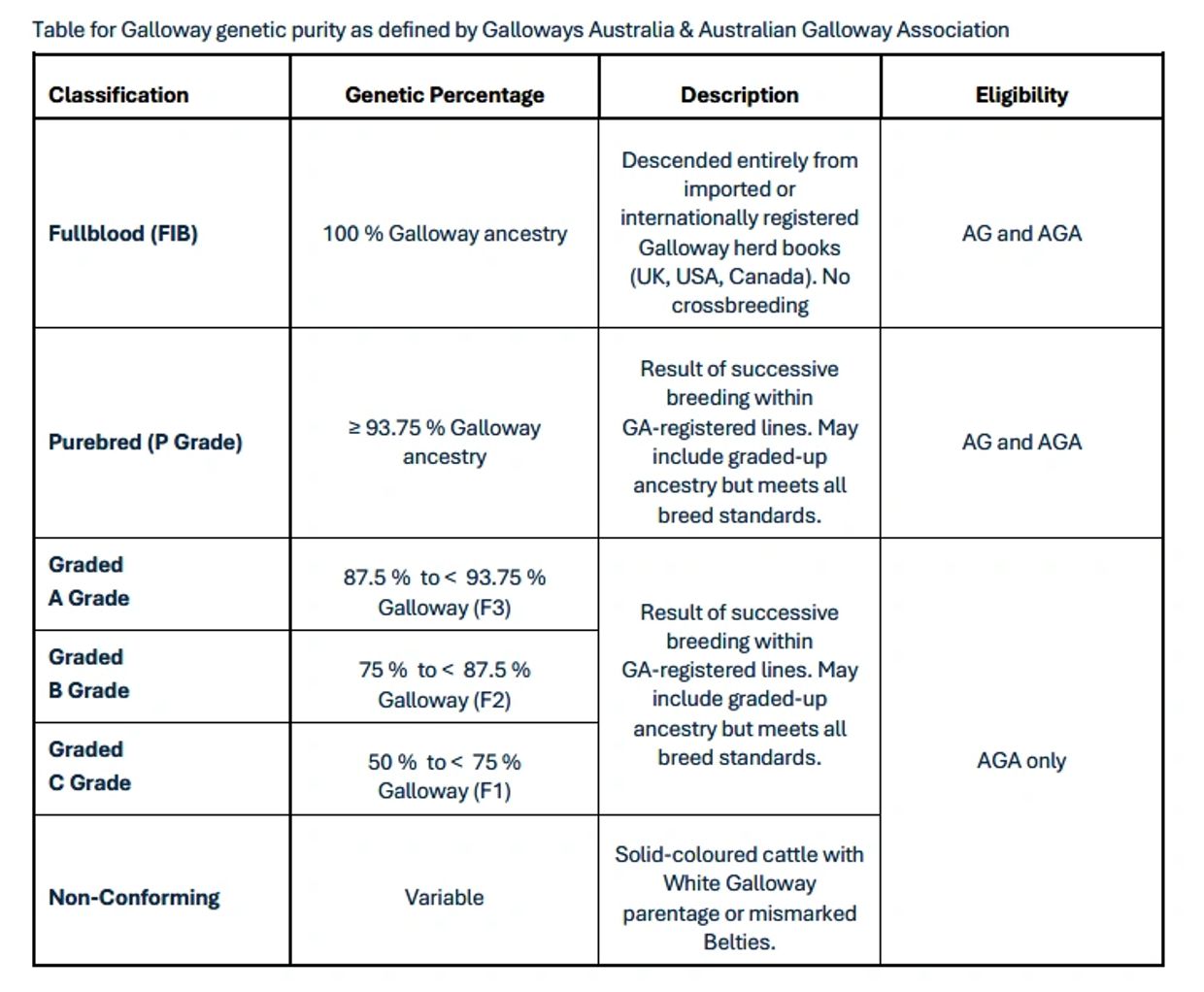
AGA / GA General Rules
- Purebred Galloways must have no non‑Galloway ancestors and conform to colour and horn‑free standards.
- Belted Galloways require at least 93.75 % Belted Galloway ancestry for full registration.
- White Galloways may derive from Section 5 parents or recognised foundation White Galloways overseas.
- Miniature Galloways follow the same genetic purity rules but add height limits (≤ 125 cm bulls, ≤ 120 cm cows).